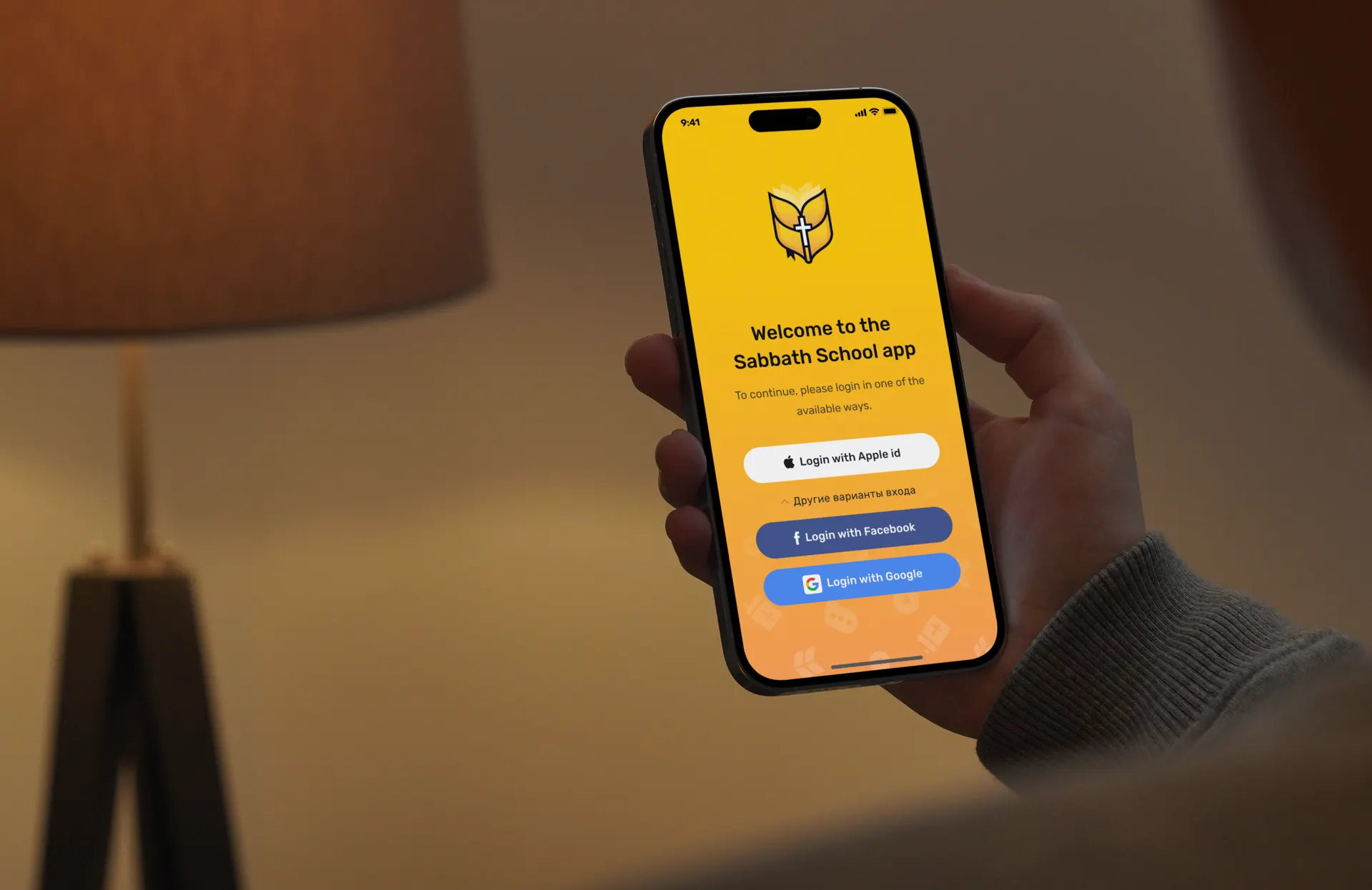
Work Euro-Asia Division Sabbath School app
A Sabbath School the division could speak into, and a lesson young people would open on a Tuesday
The Euro-Asia Division asked for a Sabbath School its young people would keep up with. Bible Vision put the quarterly on a phone, gave the division a layer of its own to write in, and sent what readers answered back as numbers.
01What they came with
The Sabbath School lesson is the one piece of study material almost every Adventist member already owns. It arrives as a quarterly: thirteen weeks, seven days each, the same text for a fifteen-year-old and for a retired teacher, printed months before anybody opens it.
The Euro-Asia Division came with a narrower worry. Its young people were reading it less every year. Not leaving, not arguing with the lesson, simply not opening it.
02What was getting in the way
Part of it is the format. Ask around a church on Sabbath morning and the answer is the same everywhere: people open the lesson on Friday night, or in the car. Not because they stopped caring, but because nothing between one Sabbath and the next asks them to. A quarterly does not know what day it is, does not know where you stopped, and gives nothing back when you do show up.
Part of it is the Bible. A lesson is a chain of references, and every reference is a small decision: put the booklet down, find the passage, lose the thread. Study that costs two objects and a free table to begin is study that happens once a week, if that.
And part of it is distance. The quarterly is written once, for the whole world. The questions it asks, the people it holds up and the situations it imagines belong to everywhere in general and so to nowhere in particular. A reader here can agree with every word of a lesson and still not recognise anybody in it. That is not a complaint about the lesson; it is what writing one text for every field costs.
03What we built
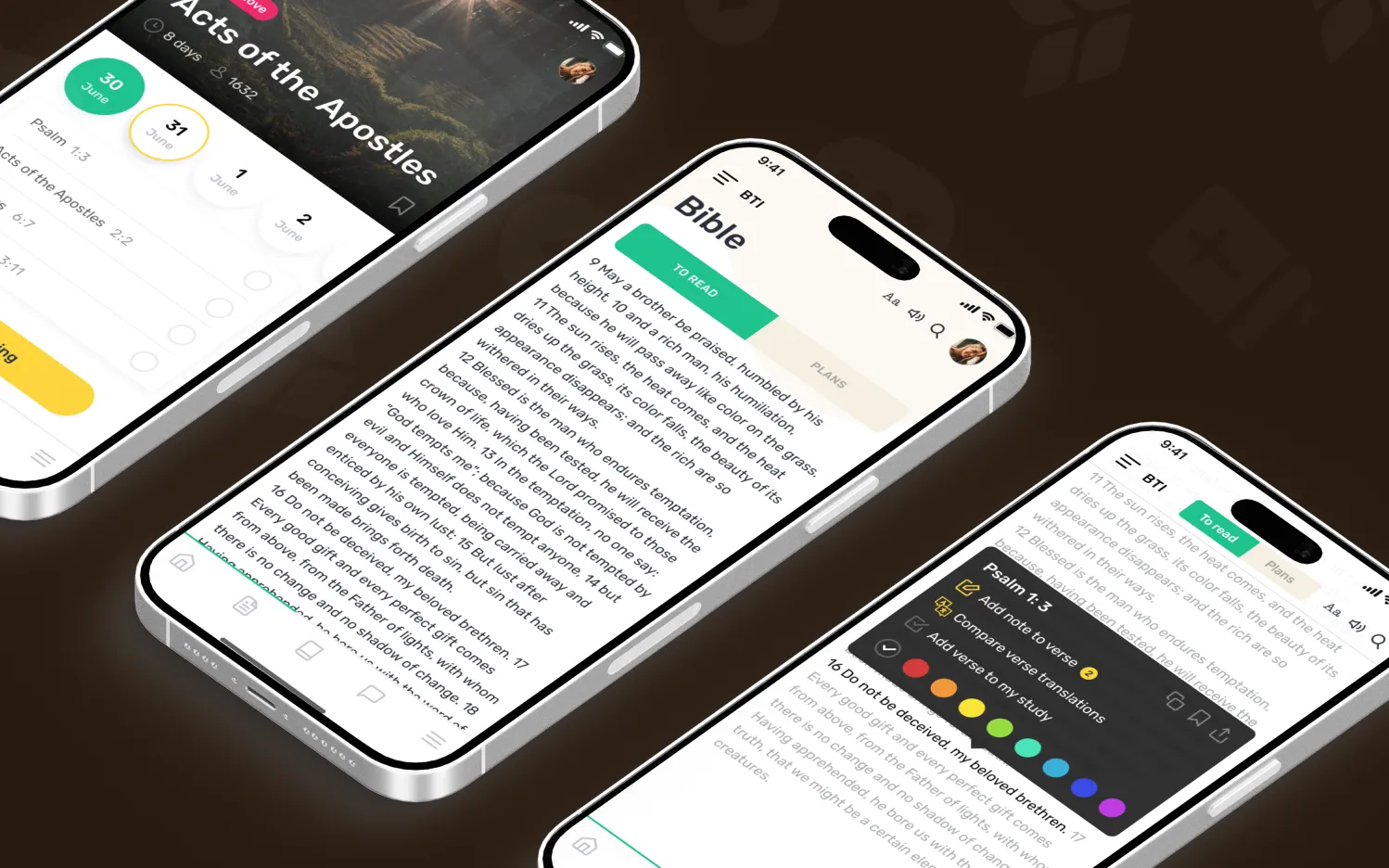
A mobile app built around the day rather than the quarter. The week opens as seven marks across the top of the screen: what is done, what is today, what is still ahead. Each day is one dated reading with its own title and photograph, so Tuesday looks like Tuesday and not like page 44.
The Bible sits inside it, and it is the part people talk about. Complete, quick, comfortable to read for an hour rather than a verse, open where the lesson sends you and closed back to the same sentence. It covers enough of what a member opens a phone for that there is little reason to leave the app at all.
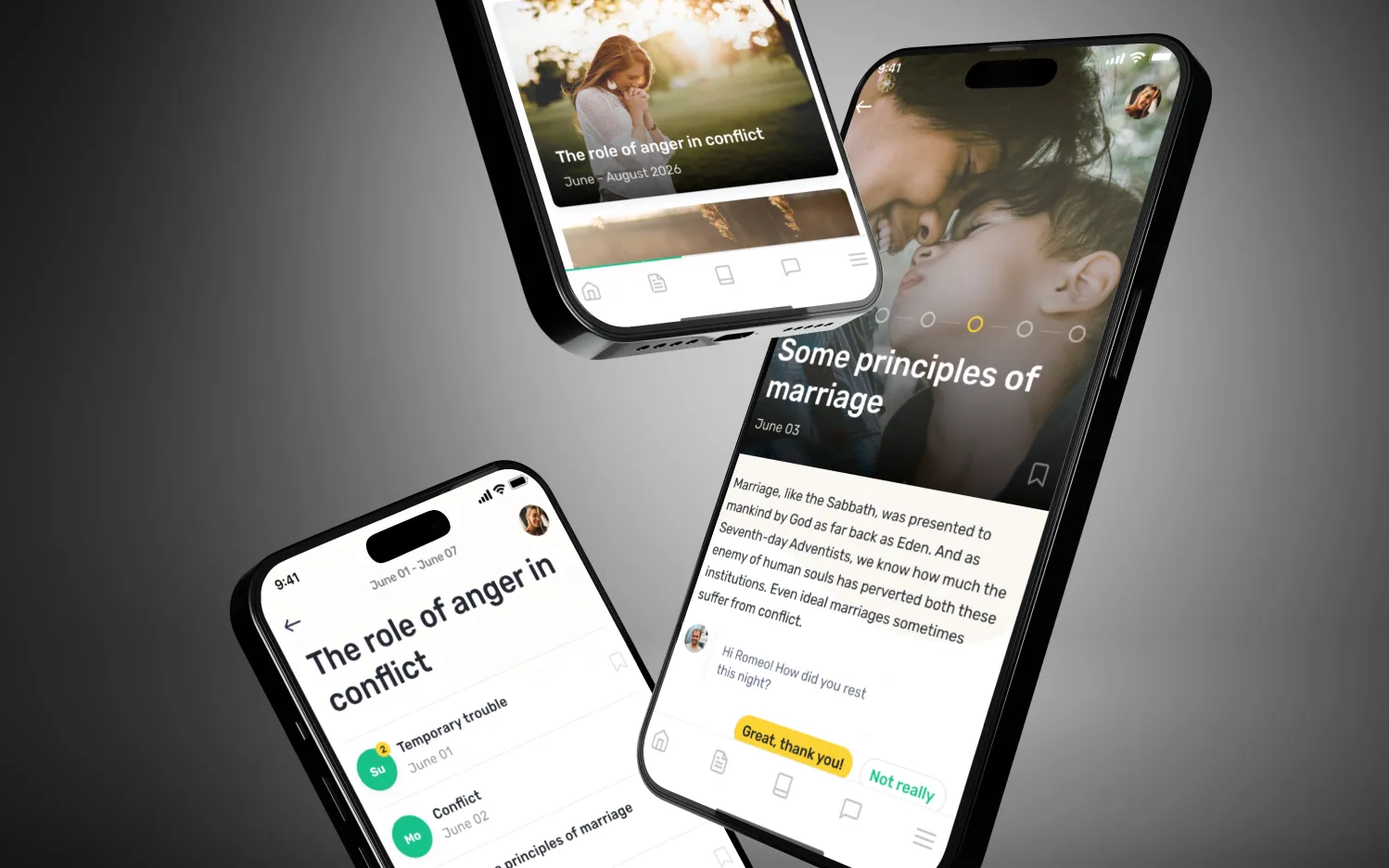
Then the part that is not a reading app at all: a second layer of content the division writes itself, carried alongside the lesson rather than instead of it. The quarterly stays exactly as it was issued. The division adds the questions, the people and the situations its own readers will recognise. A field gets to speak into its own Sabbath School without editing a word the General Conference wrote, which is the argument several divisions are having with themselves and have no mechanism to settle.
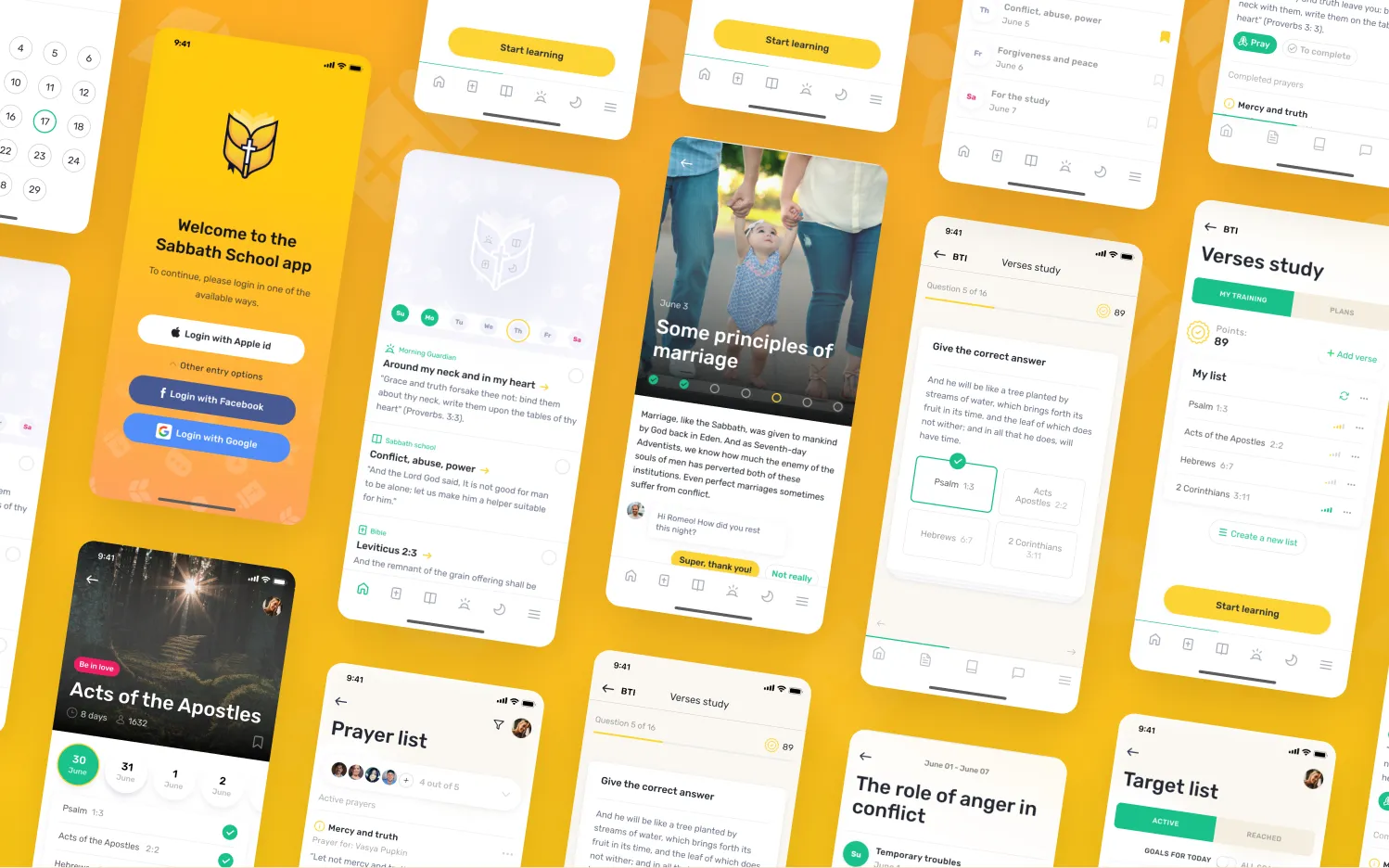
Those added questions are answerable in the app, and the answers come back as numbers. Which day of which week people finished, which question they stopped at, where a class agreed and where it split. Sabbath School has always been adjusted on what leaders report; this is the same lesson adjusted on what the people reading it actually did. Run at a global scale it would be the first time the quarterly could be written against evidence from its readers.
Over the top, a rhythm rather than a reward: four things a day — the lesson, the passage, the morning watch, the evening watch. Marked off, kept as a streak, with no leaderboard and nothing that turns Bible study into a competition with the person in the next pew.
The app carries its own name and look. Most of the design work was restraint: a reading app has to be comfortable at six in the morning and at eleven at night, on a phone held in one hand.
One piece was designed and not shipped: a class that lasts the whole week. Comment on a paragraph, send it to your own class, answer each other between Sabbaths. The hour on Sabbath morning is where Sabbath School is valuable, and the design stretched that hour across seven days. For a local church running the same lesson on a smaller scale, this is the ministry-sized version of our Sabbath School work.
04What changed
A global Sabbath School app was released while this one was in service, and the church chose to standardise on it. Bible Vision passed to the division and the project stopped being funded. The build is still there and still works; it needs a technical refresh rather than a rewrite. We would put it back into service for any division that wants the contextual layer and the reporting, because that part has not been built anywhere else.
05What this means for you
When people are not studying during the week, the instinct is to change the content: a better quarterly, a livelier teacher. Usually the content is fine and the format is the barrier. Study that needs a booklet, a Bible and a free table happens once a week. Study that fits into the four minutes before the bus can happen daily.
The second lesson is the one worth carrying further. A text written for everybody cannot also be written for somebody, and the usual answers are to rewrite it locally or to leave it alone. There is a third: leave the text exactly as it is and build a layer beside it that a field can fill. Nobody has to lose an argument, and for the first time you can measure whether any of it landed.
FAQ
Questions about this project
Could our division or conference have something like this?
Yes, and the contextual layer is the reason to. The lesson has the same shape everywhere — thirteen weeks, seven days, a fixed set of references — so the work is the content pipeline, the daily screens and the design. What is specific to your field is the layer you write on top and the questions you want answered. The first call usually makes clear within half an hour whether your scope is closer to this project or to a simpler reading app.
Who writes the lessons and the extra material?
You do. We build the pipeline and train the people who will use it, so that publishing a new quarter and its contextual questions is an editorial task rather than a development ticket. A project that needs us every thirteen weeks is a project we built wrong.
Can Bible Vision be brought back?
It can. The product exists and the concept is intact; what it needs is a technical refresh and a division that wants it. If that is you, the conversation starts with which parts you actually need: some want the whole thing, some only the contextual layer and the reporting.
Does an app like this replace the printed quarterly?
No, and it should not try. The booklet keeps working for the people who are already reading it. The app is for the members who were never going to open it on a Wednesday, and for those who study on a phone because that is what they have with them.
Have a project like this?
Tell us where you are today. The first call is a conversation, not a pitch, and the written proposal costs you nothing.