Work Three Angels Deaf Ministries Media ministry
A website that welcomes Deaf people into a community around God’s Word
Three Angels Deaf Ministries brought its ASL library, magazine, Bible school and prayer support onto one site built for people who do not hear, in their own language.
01What they came with
Three Angels Deaf Ministries had the hard part already, and decades of it: the Deaf Messenger, a quarterly magazine free to anyone who asks; Bible messages signed in American Sign Language; a Bible school; and a stream of prayer requests from people with nobody else to send them to.
What it did not have was one place where a Deaf visitor could find any of it in the order they needed it. Each part had grown where it was needed, which is how ministries grow, and the result was that the person the work was made for had to already know what to look for.
02What was getting in the way
American Sign Language is a language, not a way of spelling English with your hands. It has its own grammar, and for many Deaf people English is a second language, learned by reading rather than by hearing. That one fact breaks most of what a church website does: long paragraphs, idioms, captions pasted under a hearing speaker, a sermon archive that assumes you will listen to it.
So the question was never how to add accessibility to a site. A hearing visitor skims a page and finds the video two scrolls down; a Deaf visitor meets a wall of dense English and leaves before that video exists for them. Captions, signed video and written English each carry a different part of the same message, and a layout that assumes hearing shuts the door without ever saying so.
03What we built
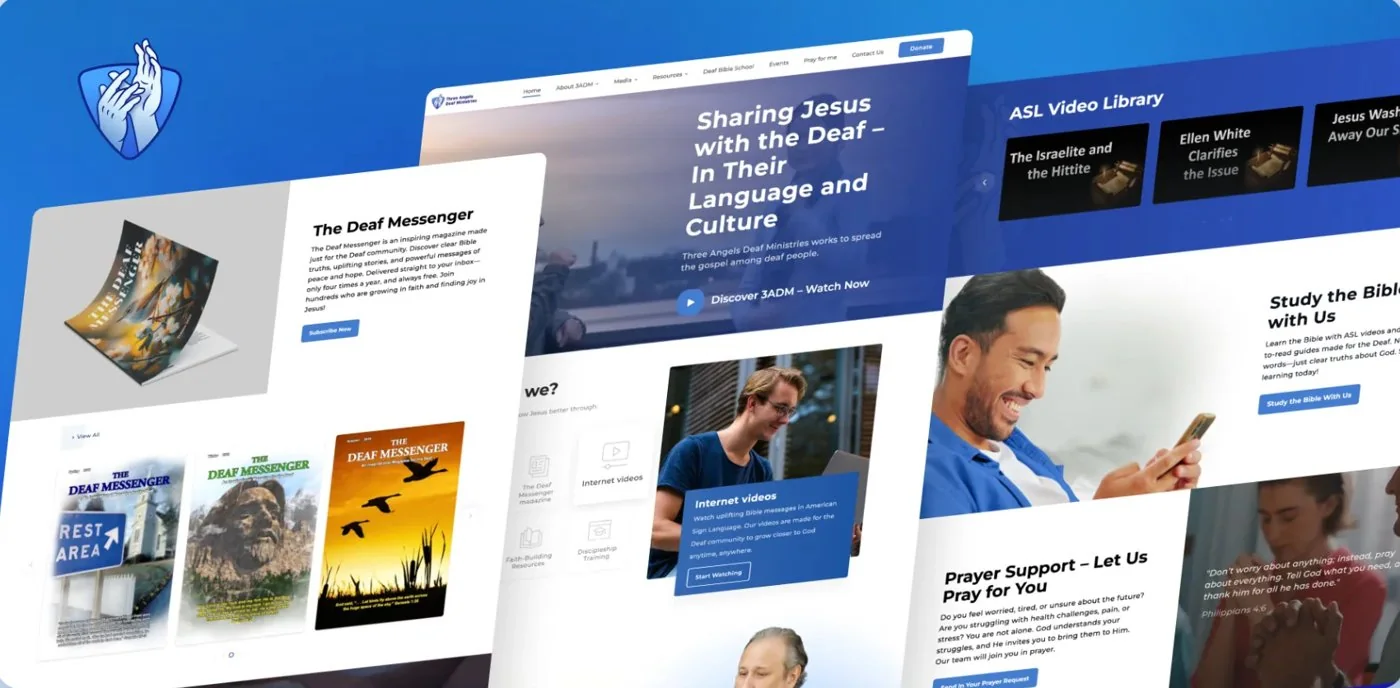
A site on the Clevio platform where video is the first language of the page rather than something attached to it. The home page opens on a signed welcome — sharing Jesus with the Deaf, in their language and culture — and the first action is to watch, not to read.
Under it, four ways in side by side, because the ministry serves four needs: the magazine, Bible messages in ASL, faith-building resources and discipleship training. Each is one step from the home page, so nobody has to guess which menu holds what they came for.
The ASL Video Library is a library rather than a feed: every message carries a title a visitor can judge at a glance, and the shelf can be browsed without playing anything.
The Deaf Bible School teaches in ASL video with written guides beside it, kept deliberately plain: no hard words, short sentences, one idea at a time. That is not simplification, it is writing for a reader whose first language is signed. The study side of the build is the same work as our online course production.
Prayer support is a form, not a phone number. For a hearing ministry the phone is the obvious channel; here it is the one channel that excludes the audience. Requests arrive in writing, and a person answers them.
The Deaf Messenger keeps its own home: the current issue, the back issues, and a free subscription four times a year. The build is web app development rather than a template, because a video library with study paths and a request queue behaves like an application — at the scale of one congregation the same structure is a church website.
04What this means for you
Accessibility is not a feature added at the end. For a ministry serving Deaf people it is the structure itself: what is reachable in one step, what is signed, and what is written plainly enough to be read rather than heard.
The test is cheap and you can run it on your own site this week. Turn the sound off and try to do the three things a visitor comes to do. If two of them need audio, the fix is not a caption track, it is the order of the page.
And plain writing is not condescension. Almost every church site is written for someone who already belongs and knows what a quarterly is, who the speaker is, what the series means. Writing for the reader who does not serves the Deaf visitor first and everybody else afterwards.
FAQ
Questions about this project
Does every page have to be signed to be accessible to Deaf visitors?
No, and trying usually produces a site nobody can maintain. What matters is that the main route through the site works without sound, that the teaching itself is signed, and that the written English around it is plain. A ministry that signs its teaching and writes its navigation simply is more usable than one that signs everything once and never updates it.
Can a ministry of our size build something like this?
Most of it transfers. The platform underneath is Clevio, which we set up for other ministries as well, so the work is the structure and the content rather than building a system from nothing. The first call tells us quickly whether your scope is closer to this project or to a straightforward website.
Who maintains the site after launch?
The ministry does. We hand over a site a volunteer can update, with training, and we stay available for the work that needs us rather than for the work that does not.
Have a project like this?
Tell us where you are today. The first call is a conversation, not a pitch, and the written proposal costs you nothing.